

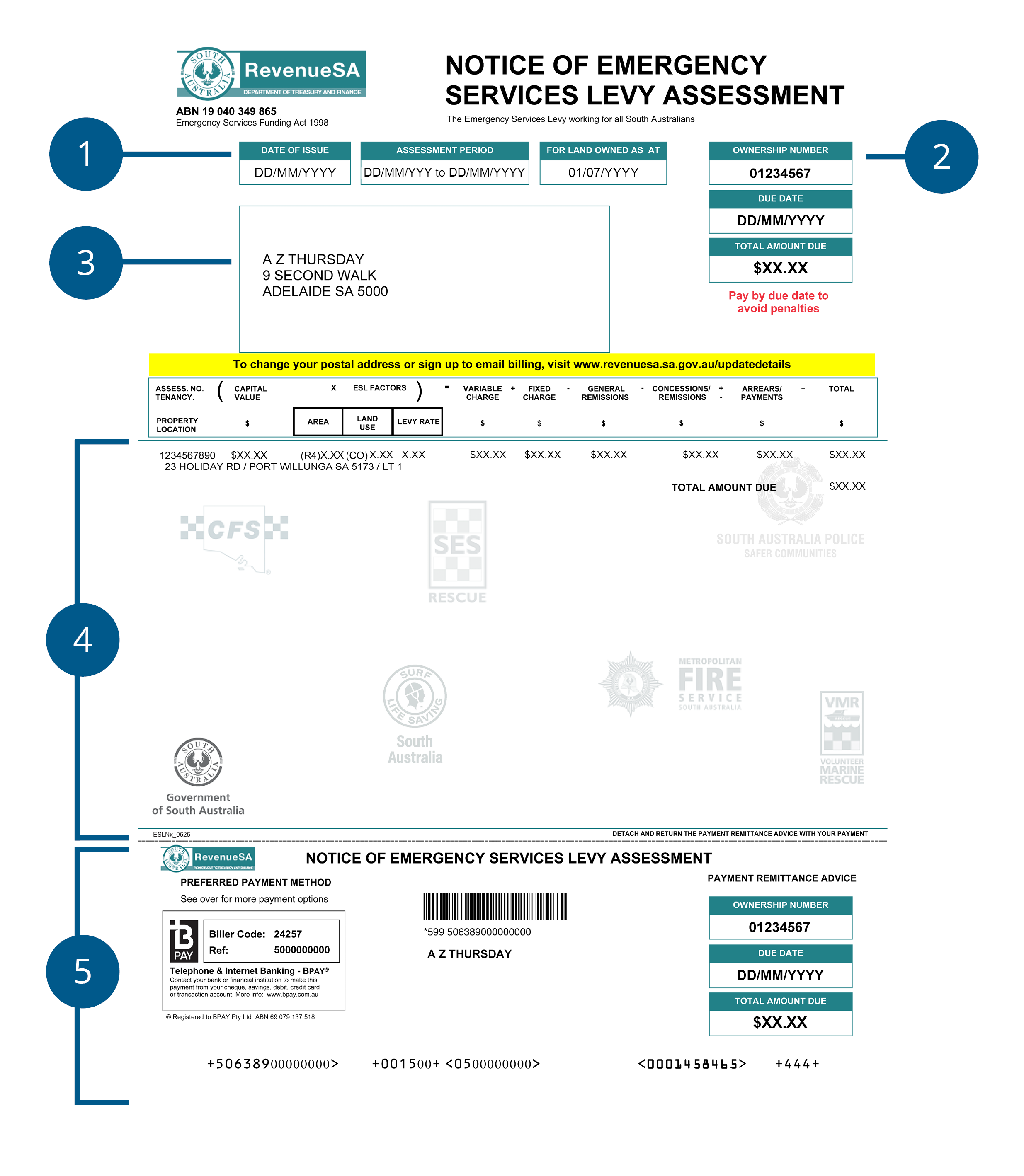
The details of the Notice of Emergency Services Levy Assessment are included here. It covers:
- the date of issue
- the assessment period
- the date upon which the assessment is based.
A unique ownership number is assigned to every unique land owner, or owners where land is jointly owned.
You will need to quote your ownership number if you contact us about your emergency services levy assessments. Your ownership number may change between ownerships.
Your Notice of Emergency Services Levy Assessment is issued in the name of the registered owner, or owners, but may be abbreviated.
If there is more than one owner, you may see the abbreviation ANR for ‘another’ or ORS for ‘others’ in the postal address section.
If you have requested that your notice be sent care of another person or company, this will be reflected here.
The top section outlines how the emergency services levy is calculated.
Find out more about how the Emergency Services Levy is calculated.
It also includes the levy details for each property in the ownership:
- Assessment number: Each property in South Australia is assigned a unique assessment number for every separately assessed property.
- Capital value: The capital value
 of the property.
 - Area: This shows which of the 4 emergency services levy areas the property falls into, along with the factor applied.
- Land use and factor: The land use category for the emergency services levy, based on the land use code attributed to the property, and the relevant land use factor.
- Levy rate: The levy rate applicable to the relevant land use category.
- Variable charge: The variable charge for the property.
- Fixed charge: The minimum fixed amount payable on each property. If there is a contiguous land reduction or single farming enterprise remission, this will be shown here as 'CL' or 'SFE'.
- General Remission: Any remissions provided by the State Government that have been applied to the property.
- Concessions / Remissions: Any other concessions, remissions or relief that have been applied to the ownership.
- Arrears / Payments : Any unpaid amounts from previous years or payments that have already been received.
- Total amount due: This represents the amount of emergency services levy that must be paid.
- Property description: The address of the property.
If you intend to pay in person or by mail, detach and return the payment remittance advice section of the Notice of Emergency Services Assessment with your payment.
Your BPAY details are also shown here.
Important: Your payment reference number may have changed since your last Notice of Emergency Services Levy Assessment was issued. Please ensure you use the correct payment reference number when making your payment.
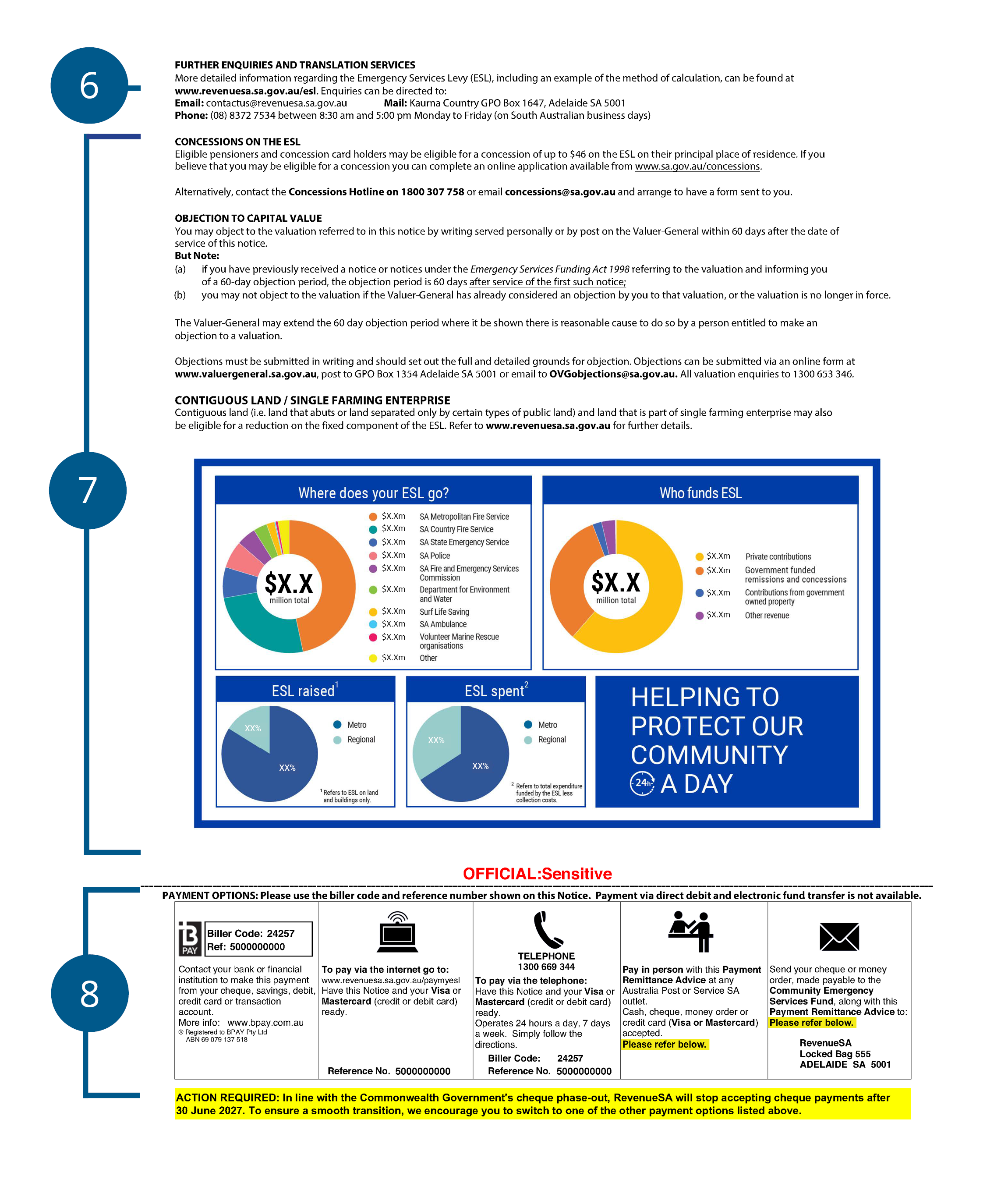
There are multiple ways you can find further information or enquire about your Notice of Emergency Services Levy Assessment.
These notes contain other important information which you should read carefully.
All available payment options and details are shown here.
Important: Your payment reference number may have changed since your last Notice of Emergency Services Levy Assessment was issued. Please ensure you use the correct payment reference number when making your payment.
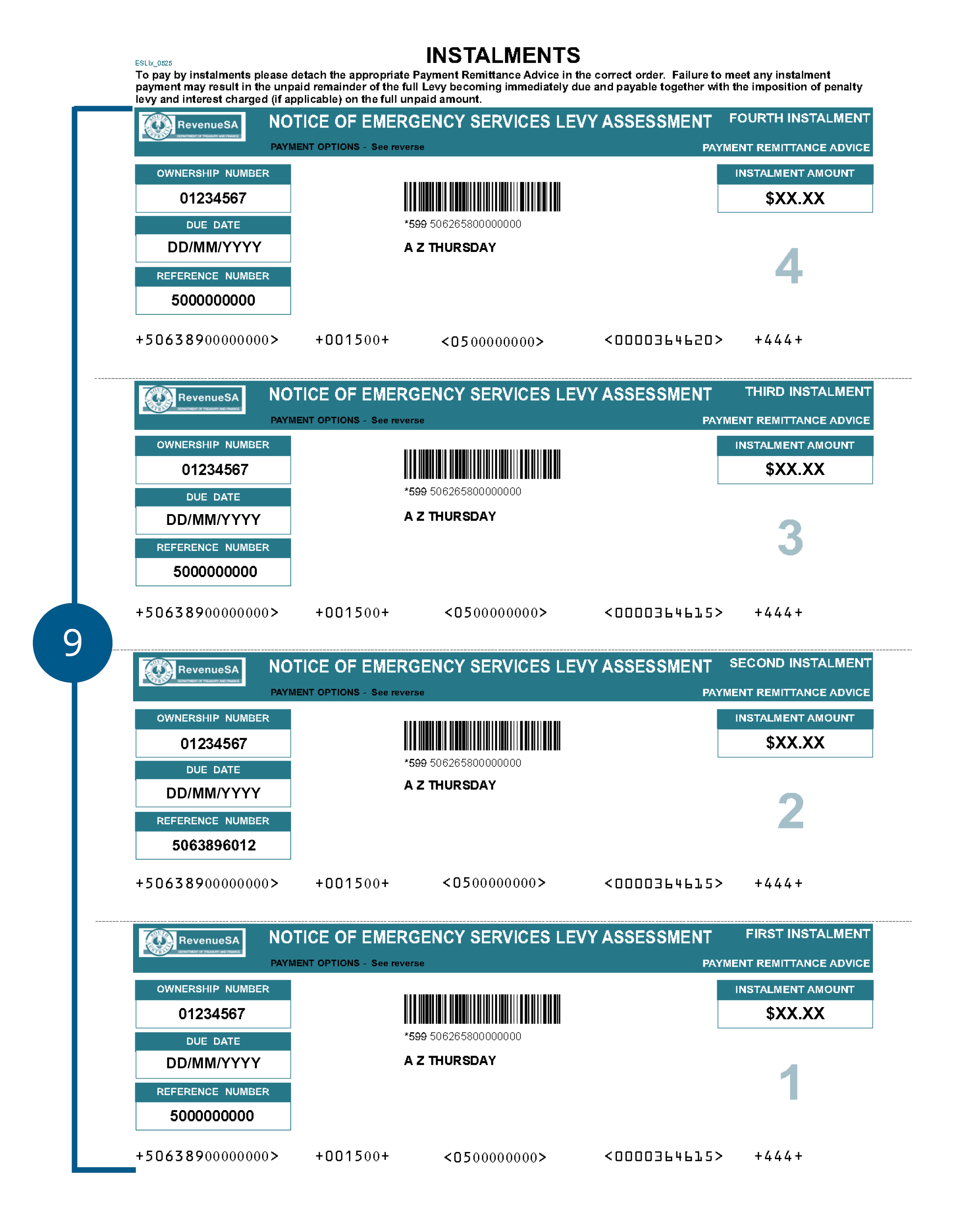
If you have chosen to pay by instalments, the payment details (amount and due date) for each instalment will be outlined in the payment remittance advice slips, which can be detached and included if you intend to pay in person or by mail.
All payment options are also shown on the other side of the slips.
Important:
- Failure to meet any instalment payment may result in the unpaid remainder of the full levy becoming immediately due and payable. Interest and penalty levy may also be charged on the full unpaid amount.
- Your payment reference number may have changed since your last Notice of Emergency Levy Assessment was issued. Please ensure you use the correct payment reference number when making your payment.